
Domestic Violence Resources
Are you anxious or fearful about how your spouse, partner, or someone from a past relationship is treating you?
Are you concerned that a friend, a family member, or someone else in your life is possibly being controlled or hurt by their partner?
Are you struggling with the effects of an abusive partner on your wellbeing and need some support — even if it is years later?
If you answered “yes” to any of the above, our membership is here for you.
Reach out directly to one of the organizations listed below, or call the statewide domestic violence helpline to connect with an advocate near you: 1-866-834-HELP.
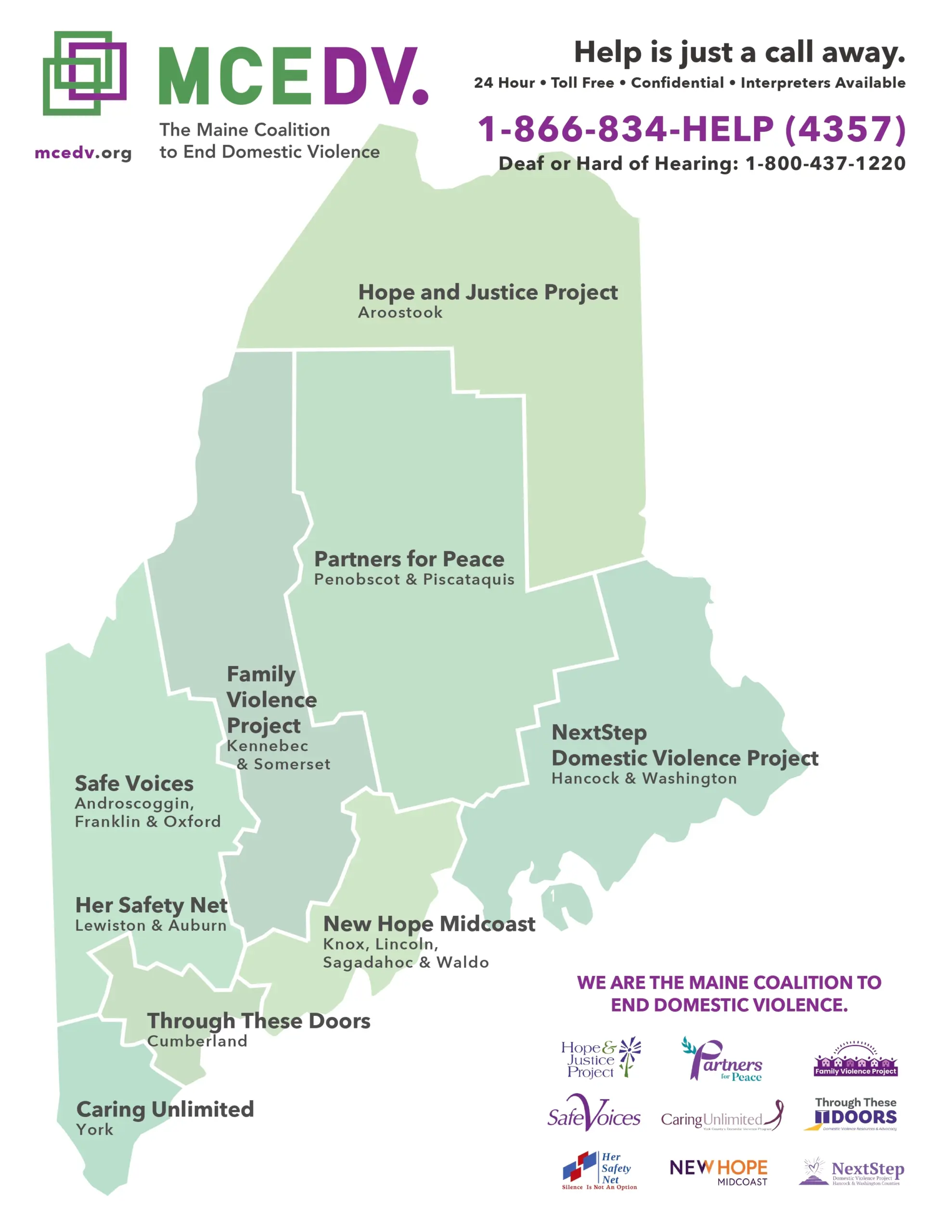
- Hope & Justice Project: Serving Aroostook County
- NextStep Domestic Violence Project: Serving Washington & Hancock Counties
- Partners for Peace: Serving Penobscot & Piscataquis Counties
- New Hope Midcoast: Serving Waldo, Knox, Lincoln, & Sagadahoc Counties
- Family Violence Project: Serving Kennebec & Somerset Counties
- Her Safety Net: Serving Immigrant, Refugee, Asylum Seeking and BIPOC (Black, Indigenous, and People of Color) Communities in the Lewiston/Auburn area
- Safe Voices: Serving Oxford, Franklin & Androscoggin Counties
- Through These Doors: Serving Cumberland County
- Caring Unlimited: Serving York County
Additional Resources
FAQs about Domestic Violence Services in Maine
What is a domestic violence advocate?
Anyone can – and everyone should – support survivors. But not all support is the same. Advocates play a unique role and have valuable expertise.
Under both federal and state law, advocates are prohibited from sharing a survivor’s information without their consent. Their privilege shields them from being compelled to testify in court against the will of a survivor – for example, at the behest of an abusive partner or a system that wants the information.
Advocates receive extensive, Maine-specific training in domestic abuse and violence. And they carry the lessons learned from tens of thousands of survivors who have been helped by their organizations. They are trained not to give advice, but to explore, ask questions, provide information, strategize with, and support survivors in deciding their next steps.
Advocates are not attorneys. They are trained experts in domestic abuse and violence who are ready to combine what they know with each survivor’s expertise in their own situation, to explore the risks and help find safety.
What services do advocates offer?
The core service offered by our member advocates is safety planning. Advocates help survivors examine the risks they are facing and identify the options to lessen those risks. They help survivors choose what to do – including when there are no good choices. And then they help identify a new plan when things shift – which they almost always do, because abusive people usually keep trying to maintain control.
MCEDV’s members offer an array of services and resources to help survivors and their children. Those include support groups, sheltering programs, housing navigation, court advocacy, financial assistance, and connections to legal representation. Availability of some services can be limited by resource constraints. But an advocate is always available to offer safety planning and support.
What is it like to call the helpline?
Our statewide helpline, 1-866-834-HELP, connects callers with advocates at their member Domestic Violence Resource Centers. Mainers can also reach a local advocate directly by calling their DVRC-specific helpline number: view here. Calling is free and confidential. Help is available at any time, day or night.
Your call will be answered by an answering service, who will collect some basic information and have an advocate quickly call you back. If getting a call back isn’t safe for you, that’s OK. Just let the answering service know.
When you speak with an advocate for the first time, they will listen and ask questions to understand your situation and the level of risk you might be in. You might call the helpline looking for a specific resource, or you might just want to ask questions and get a sounding board. Either is OK. Through the conversation, the advocate will share information about options that could be helpful in your specific situation and explore if you think they would be helpful. Sometimes those options are offered by their resource center, and sometimes they connect you with other organizations who can help with pieces of what you need.
Is what I am experiencing abuse?
If you are wondering if what your partner is doing is abusive, ask whether they…
- Call you disrespectful names, or criticize your choices and decisions?
- Monitor or control where you go, what you do, and who you spend time with?
- Hurt or threaten to hurt you physically or sexually – including if you disagree with them?
- Pressure you to engage in sexual activity when you don’t want to?
- Misuse technology to track your location without your consent?
- Make you feel afraid?
If you answered “yes” to any of the above, our member advocates are here for you. Call the statewide domestic violence helpline to be connected with support near you: 1-866-834-HELP. Deaf or hard of hearing? Call 1-800-437-1220.
What if I am worried about someone else?
Survivors need the support of the people in their lives. Some of the most important work advocates do is help Mainers know how they can help the survivors they care about. Advocates can give insight into what the survivor in question might be going through and identify ways you could offer to assist. They can also help manage the feelings that often come up when someone you know is being abused. If you want to support someone you know, calling the helpline to speak with an advocate is a great start.
Is everything I tell an advocate confidential?
Yes – with a few narrow exceptions. Under Maine law, advocates are mandated reporters of child abuse and neglect, and the abuse and neglect of incapacitated or dependent adults. Advocates who hear about those things are required to make a report to the appropriate authorities – and they will work with you to address any safety concerns that the report might create.